
How Arrest Warrants Work in Kalkaska County
Michigan does not leave this to a deputy's judgment; an arrest warrant starts with a sworn complaint. Under Michigan Court Rule 6.102 and MCL 764.1a, the complaint goes before a magistrate or clerk, and a judicial officer weighs whether the facts justify a warrant or a summons. Reasonable cause can rest on an affidavit, sworn testimony, or a supplemental filing. The paper trail stays thin at that stage. Most Kalkaska County warrant cases begin in the 87-B District Court. Its magistrates issue arrest and search warrants, hold arraignments, set bond, and remand a defendant. What they cannot do is run a preliminary examination or a trial. Those steps belong further up the ladder.
The Kalkaska County Arrest Warrant Complaint Process
In Kalkaska County, an officer or the prosecutor prepares the complaint and brings the supporting facts to a judicial officer, drawn from a police report, a written affidavit, or live testimony. The judge or magistrate then reviews that material independently and decides whether probable cause exists. That review is the whole point of the step. Michigan publishes blank forms that show the shape of this paperwork. MC 200w is the felony warrant form, and MC 200s is the summons version. Neither one is a person's record. They simply list the fields an issued order carries, so a reader can see what the court already holds.
Note: A blank form shows the fields an order carries, but it is not a record from a case.
Arrest Warrants: What They Contain
An arrest warrant is a short command attached to a longer case file. It names the offense and directs the arrest. A Kalkaska County file can carry these fields.
| Court and County | The district and county that issued the order. |
|---|---|
| Case Number | The court's number, for example Case No. 000000-XX. |
| Offense Charged | The alleged crime named in the complaint. |
| Probable Cause Basis | The facts a judicial officer reviewed before signing. |
| Issuance Date | The day the order took effect. |
| Bond or Amount | Set by the judge or magistrate, not a payment screen. |
| Return of Service | Whether and how an officer served the order. |
A missing field is normal. Some identifiers stay out of the public file.
Note: Public files may leave out identifiers, so ask the clerk which fields the court will release.
Kalkaska County Summons Versus Arrest Warrant
Michigan materials favor a summons in many cases. A summons sets a court date and skips the immediate arrest. Courts still ask for a warrant when the allegations are assaultive or involve domestic violence, when there is reason to doubt the person will appear, when public safety is at stake, or when a prosecutor requests one. That choice shapes a person's first contact with the court. A summons arrives as a date on paper. A warrant arrives as arrest authority, and it can surface during any police contact. Neither paper decides the case.
How Warrants Get Served in Kalkaska County
The Kalkaska County Sheriff's Office serves arrest warrants through its Civil Process/Warrants division, which also carries civil papers, transports prisoners, and supports court security. Deputies then file a return after serving an order. The return records what happened. Service is not always theirs, though. Another agency may serve a Kalkaska County warrant that started in its own jurisdiction: village police handle a village case, the Michigan State Police handle state matters, and federal officers handle federal process. The county lays out the felony path that follows an arrest on its official site.
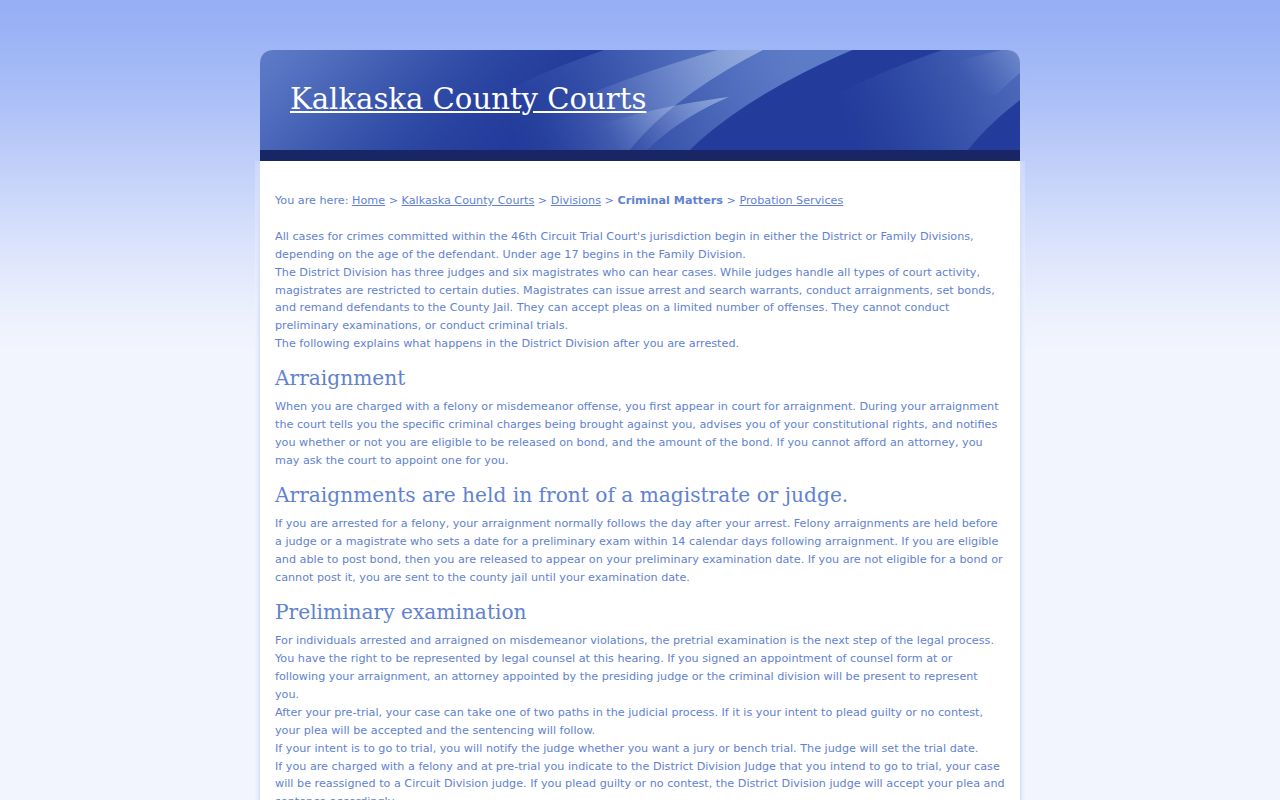
For the steps after an arrest in Kalkaska County, the criminal matters page gives the clearest public account. Read it before you call.
Kalkaska County's Felony Warrant Path to Circuit Court
Kalkaska County's criminal page says a felony arraignment is normally held the day after an arrest, with a preliminary examination set within fourteen calendar days and bond addressed at the arraignment. Confirm current dates with the court. If the district judge finds probable cause at that examination, the case is bound over to the 46th Circuit Court. The file belongs to the circuit court from that point. Its clerk keeps the record. A served warrant and a resolved charge are separate events. Serving one does not close the other.
Arrest Warrants, Summonses, and Bench Warrants
Three papers can bring a person into court, and they begin in different places.
| Feature | Arrest Warrant | Summons | Bench Warrant |
|---|---|---|---|
| How It Starts | A sworn complaint and a probable-cause finding | A complaint, with a date instead of arrest | A missed hearing or compliance step |
| Who Signs It | A judge or magistrate | A judge or magistrate | The judge in the existing case |
| What It Commands | Custody and a court appearance | An appearance on a set date | Custody for the missed obligation |
| How It Ends | Arrest, bond, and further court action | Appearance, plea, or dismissal | Appearance, recall, or quash |
The top line of the document tells you which one you have.
Where to Ask About a Kalkaska County Arrest Warrant
A Kalkaska County warrant question can land at three counters. The court explains the case, the sheriff explains service, and the jail explains custody and bond logistics. Not sure which office signed the order? A Kalkaska County warrant check traces the clerk first.
87-B District Court, District Division
605 North Birch Street
Kalkaska, MI 49646
231-258-9031
Kalkaska County Sheriff, Records Division
605 North Birch Street
Kalkaska, MI 49646
231-258-8686 ext. 1410
Kalkaska County Jail
Custody and bond questions
231-258-8686 ext. 1405
Records staff will also say when another agency holds the file.
Handling an Arrest Warrant in Your Name
These steps are procedural, and the Kalkaska County court controls them. Work them in order. Write down what you do at each step.
- Identify the issuing division from the notice or the case number.
- Call the clerk before appearing and ask what the court requires.
- Ask about counsel, and about appointed counsel if money is tight.
- Follow the court's appearance or bond instruction instead of improvising.
- Address the underlying case, then ask for written proof of what the court did.
Important: Do not test an open warrant with a traffic stop or a walk-in visit. Talk to a Michigan attorney first, then follow the court's instructions.
Public Access to Kalkaska County Arrest Warrant Files
Kalkaska County court papers, such as a warrant order or a recall order, belong to the clerk holding the file, and MCR 8.119 governs that access. Agency papers sit elsewhere. An incident report belongs to the sheriff. The Michigan Freedom of Information Act, 1976 PA 442, MCL 15.231 et seq., governs those requests.
Key Rules:
MCL 15.235 - A public body generally answers a written request within five business days.
MCL 15.243 - Investigative records may be withheld to protect a proceeding, privacy, or safety.
MCL 780.651 - A search-warrant affidavit usually stays nonpublic until the fifty-sixth day.
A narrow request that describes an existing record works better than a broad one.